Congress Proposes Rules That Will Impact IRA Plans

UPDATED OCTOBER 28TH, 2021
Per the modified “Framework” for the Build Back Better Act presented by President Biden on October 27th, all proposed retirement plan changes have been dropped from the FY2022 Budget Act. Until the final law is signed, there is remaining uncertainty, but it seems unlikely these proposals will become law.
On September 13th the House Ways and Means Committee released proposed language for the FY2022 Federal Budget that will impact IRA plans. These changes will limit investor choice and may force some investors to sell or distribute investments they have already made in their IRA.
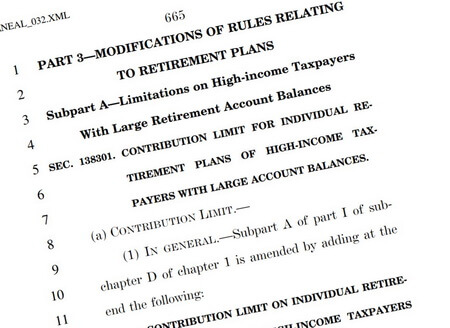
Following are the IRA related changes in the draft language for the budget bill.
Whether you are an IRA investor, an entrepreneur or real estate developer who relies on capital from IRA plans, or just someone who believes in the principles of investment diversification and choice, you should be concerned about these proposals.
What is the Reasoning?
The proposed changes to IRA plans are a reaction to some high-profile cases of wealthy individuals using IRAs for abusive tax avoidance schemes.
If you have heard how Peter Thiel amassed a $5 billion tax free Roth IRA starting in 1999 with a purchase of 1.7 million shares of PayPal for $1,700 in a sweetheart insider deal, you understand the motivation.
IRA plans were never intended to be a tax avoidance vehicle. Rather, the tax-favored status of IRA plans is meant to facilitate the ability of average Americans to save for retirement.
The reasons and motivations for making changes are legitimate. The proposed language in the bill does not exactly align with those stated intentions.
What are the Proposed Changes?
Many of the proposals apply only to individuals classified as being high-income. This is defined as having taxable income over $400,000 if single, $450,000 if married filing jointly, or $425,000 if filing as head of household. All such income thresholds will be adjusted for inflation over time.
No New Contributions for Large IRAs of High-Income Taxpayers (section 138301): If an Individual has more than $10 million in IRA savings and is deemed high income, they cannot continue to make new IRA contributions to either a traditional or Roth IRA.
This change would take effect in tax years beginning after December 31st, 2021.
Very few investors will be impacted. Tax incentives are not necessary to encourage retirement savings in excess of $10 million.
Required Distributions for Large IRAs of High-Income Taxpayers (section 138302): High income individuals with combined IRA, Roth IRA, and defined contribution retirement plan (i.e. 401(k)) balances over $10 million are required to take distributions in the amount of 50% of the balance over $10 million.
If the total plan savings is greater than $20 million a distribution from Roth accounts must be taken that meets the lesser of reducing to $20 million the total savings or the aggregate balance of Roth savings in in IRA and employer plans. Once this has been accomplished, a distribution of 50% of the remaining amount over $10 million can be taken from either tax-deferred or Roth accounts.
This change would take effect in tax years beginning after December 31st, 2021.
Very few investors will be impacted, though there could be a substantial tax bill for those who are. Tax incentives are not necessary to encourage retirement savings in excess of $10 million.
Restrictions on Roth Conversions (section 138311): The capacity to make Roth IRA contributions has always been limited by income. For example, as of 2021 an individual with taxable income over $140,000 cannot make a Roth IRA contribution, though they can contribute to the designated Roth account in a 401(k) style employer plan.
In 2010 similar limits on making Roth conversions were removed. This allowed anyone regardless of income to contribute to a Roth IRA by first making a non-deductible contribution to an IRA or 401(k) and then performing a Roth conversion. This is referred to as a “back-door” Roth contribution.
This section of the bill will end such back-door strategies for high-income taxpayers by eliminating the ability to perform Roth conversions in either an IRA or a qualified employer plan. Roth conversions will still be available to investors below the high-income thresholds.
The new rule will also prohibit after-tax contributions in qualified employer plans and, while still allowing for non-deductible contributions to an IRA, will prohibit Roth conversions of those amounts. This restriction will apply to all individuals regardless of income.
While these changes may impact a slightly larger group than the prior sections, it will still be limited to high-income individuals. At that threshold, Roth conversions could arguably be considered as tax avoidance strategies, not necessarily just enhanced savings techniques.
Prohibition of Investments Conditioned on IRA Account Holder’s Status (section 138312): This section of the bill will prohibit an IRA from holding any asset that requires the IRA account holder have a minimum level of income, assets, or education, or hold special certifications.
Impacted investments will include most real estate syndications, crowdfunded ventures, and privately traded funds or REITS that typically required accredited investor or sophisticated investor status. Private placements formed using rule 506(b) or rule 506(c) of SEC Regulation D will be prohibited.
No new investments of this type will be allowed after December 31st, 2021. Any such investments already held within an IRA will need to be sold or distributed in-kind from the IRA by December 31st, 2023.
The impact of this proposal is significant and will be discussed below.
Extend Statute of Limitations for IRA Non-Compliance (section 138313): The IRS will now have 6 years instead of just 3 to pursue violations of prohibited transaction rules or valuation related mis-reporting issues with IRA accounts.
Prohibition of Investments where IRA Owner has Substantial Interest or Control (section 138314): This new rule will prohibit an IRA from investing in a corporation, partnership, non-incorporated business like an LLC, or trust where the IRA account holder has 10% or greater ownership stake – directly or indirectly.
Entity investments will also be prohibited if the IRA owner holds a position as a director, officer, or equivalent with the entity.
While meant to strengthen existing prohibited transaction rules against the type of insider self-dealing Peter Thiel engaged in when he controlled PayPal, this will also impact the popular and widely used Self-Directed IRA structure referred to as a Checkbook IRA. The ability of an IRA account holder to act as a non-owner manager of an LLC owned by their IRA would be eliminated.
No new investments of this type will be allowed after December 31st, 2021. Any such investments already held within an IRA will need to be sold or distributed in-kind from the IRA by December 31st, 2023.
The impact of this proposal is significant and will be discussed below.
Funding of the IRS (section 138401): The IRS has been underfunded for some time, which hampers the ability to track down abuses. In allocating nearly $80 billion specifically to tax enforcement and technology updates and $157 million to the tax courts, congress is looking to solve that problem. The language specifies that none of the new enforcement budget is to be used to increase taxes on taxpayers with taxable income below $400,000.
What Impact Will This Have If Passed?
Most of the new proposals make sense. While limitations on back-door Roth contributions for wealthier investors may result in some complaining, the average investor will not be impacted. These regulations are in line with the goal of restoring the IRA to a savings mechanism rather than a tax-dodge.
Sections 138312 and 138314 will do real harm while producing little if any benefit in terms of generating revenue to support the larger aims of the budget proposal or reducing tax abuses.
By prohibiting investments in private placements and IRA-LLC structures, investor choice will be limited. When IRA plans were created in 1974, only two asset types were prohibited: life insurance and collectibles. The purpose of an IRA is to allow people to save responsibly for their future, and it is not the business of government to tell them where to hold that savings. By taking a whole range of quality private placement opportunities off the table, investors are being forced into what Wall Street sells. The ability to be truly diversified will be greatly diminished as a result.
This change represents a reversal of actions taken in the last 10 years to give more investors access to the high performing assets that have always been available to the wealthy. The 2012 Jobs Act opened the door for accredited and some non-accredited investors to participate in commercial real estate, private equity, and non-traded funds. In 2020, the SEC expanded the definition of an accredited investor to further this effort.
The more significant impact of these two proposals will be felt by those who have already made investments into what may soon become disallowed assets for an IRA.
IRA investors holding private securities will be forced to sell within 2 years or face disqualification of their IRA. Most private placements are longer term in nature, often with 7–10-year maturity. Selling out of such an illiquid asset early may not be possible or may require taking a significant discount in exchange for liquidity. Ironically, it will be exactly those ultra-wealthy individuals the law is aiming to have “pay their fair share” that will be out scooping up these bargains.
If an investor cannot sell an asset, they may be forced to take a distribution of the asset in-kind. This will produce a taxable event. There is no mention of a waiver on the 10% penalty for early distribution if the IRA holder is under age 59 ½, so add some insult to that injury.
What about Checkbook IRA Holders?
The Checkbook IRA structure that has been in use since the early 1990’s will be impacted by section 138314 prohibiting the IRA account holder from acting as director for their IRA-owned entity.
A possible solution will be to appoint a trusted individual to act as the LLC manager. Before the bill becomes law and the IRS has a chance to draft appropriate regulations, this solution is uncertain, as is the question of who might be able to fill that manager role. It may be as simple as appointing a spouse or sibling, or it may be necessary to hire a 3rd party corporate trustee like a law firm.
While a 3rd party LLC manager might reduce some of the benefits of checkbook control, this alternative could at least provide a better exit path for plan holders than a 2-year forced exit.
If an IRA LLC is not holding prohibited investments per section 138312, the LLC could be dissolved and the assets held directly by an IRA custodian. This is a less efficient way to operate, but again, better than an involuntary liquidation of the asset.
Other Economic Impacts
In addition to penalizing IRA account holders who made legal investments, the prohibition against holding private placements will impact the main street economy of builders, real estate deal sponsors, small fund managers, and innovative small businesses and startups that will lose access to this capital.
Proponents of the budget claim their proposals will decrease income inequality and force the ultra-wealthy to contribute more towards societal goals. The IRA changes in sections 138312 and 138314 will accelerate the concentration of wealth.
Are Solo 401(k) Plans Impacted?
The problematic sections 138312 and 138314 specifically apply to IRA plans and do not mention employer qualified retirement plans such as a 401(k).
For some IRA investors who hold private placements or other newly prohibited IRA assets, there may be the option to rollover to a Solo 401(k). A person will need to legitimately qualify for the Solo 401(k) by being self-employed and having no full-time employees in any business they control.
Unfortunately, even if someone can setup a Solo 401(k), they will not be able to rollover an existing Roth IRA. A 401(k) cannot accept a rollover from a Roth IRA.
Section 138311 will impact Solo 401(k) plan holders and shut down the back-door Roth contribution strategy.
What Investments are Still Allowed?
Even if the bill passes, there will be many ways investors can choose to diversify into real assets that are decoupled from the stock market. It will still be possible to hold:
- Real Estate that is directly held by the IRA
- Small real estate partnerships and joint ventures that do not involve a regulated security offering
- Mortgage notes, trusts deeds, and other lending instruments
- Closely held businesses and startups that do not involve a regulated security offering
- Cryptocurrencies
- Precious metals
- Tax liens & deeds
- Oil, gas and other mineral rights
- Commodities
- And many other assets
What Should You Do if You Already Hold Assets in your IRA that may be Prohibited?
Do not panic. Do not call your plan provider and ask if you should sell investments. Unless and until the sky actually falls, the sky is not falling.
It is very possible these proposals may get removed from the bill before final passage. It is also possible that the whole budget bill fails if the Democrats cannot get every single Senator and all but 3 house representatives on board.
If these proposals become law, you will have two years to come up with a contingency plan.
If you are considering making a new IRA investment in a private placement, it may be better to hold off until the fate of these proposals is determined. It is unlikely the legislative process will extend beyond early December before the bill passes – with or without these proposals – or fails.
The single best course of action right now is to advocate against these changes by contacting your legislators.
How Can I Make My Voice Heard?
Visit our Save Our IRAs page for resources. Learn how to find out who your representatives and senators are and how to contact them. We have also drafted sample letters you can use to template your own message.





What our clients says about us

Quick answers to common questions
We’ll take you through a simple, step by step process designed to put your investment future into your own hands…immediately. Everything is handled on a turn-key basis. You take 100% control of your Retirement funds legally and without a taxable distribution.
YES! In 1974, Congress passed the Employee Retirement Income Security Act (ERISA) making IRA, 401(k) and other retirement plans possible. Only two types of investments are excluded under ERISA and IRS Codes: Life Insurance Contracts and Collectibles (art, jewelry, etc.). Everything else is fair game. IRS CodeSec. 401 IRC 408(a) (3)
It’s actually pretty simple. Early on, regulators let the securities industry take the lead in educating the public about retirement accounts. Naturally, brokers and banks promoted stocks, bonds, and mutual funds—giving the impression that those were the only allowed investments. That was never true... and still isn’t. You can probably guess why they kept the rest under wraps.
It is possible to use funds from most types of retirement accounts:
- Traditional IRA
- Roth IRA
- SEP IRA
- SIMPLE IRA
- Keogh
- 401(k)
- 403(b)
- Profit Sharing Plans
- Qualified Annuities
- Money Purchase Plans
- and many more.
It must be noted that most employer sponsored plans such as a 401(k) will not allow you to roll youraccount into a new Self-Directed IRA plan while you are still employed. However, some employers will allow you to roll a portion of your funds. The only way to be completely sure whether your funds are eligible for a rollover is by contacting your current 401(k) provider.
A Solo 401(k) requires a sponsoring employer in the format of an owner-only business. If you have a for-profit business activity – whether as your main income or as a side venture – and have no full-time employees other than potentially your spouse, your business may qualify. The business may be a sole-proprietorship, LLC, corporation or other entity type.
A self-directed retirement plan is a type of IRA or 401(k) that gives you greater control over how your retirement funds are invested. Unlike traditional accounts held at banks or brokerage firms that limit you to stocks, bonds, and mutual funds, self-directed plans allow you to invest in a wide range of alternative assets including real estate, private businesses, precious metals, cryptocurrency, and more.
These plans still follow the same IRS rules and maintain the same tax-deferred or tax-free benefits as conventional retirement accounts. The difference is simply in how and where you choose to invest.
No. Moving to a self-directed IRA or Solo 401(k) does not trigger any taxes, as long as your funds are eligible for rollover.
Self-directed retirement plans maintain the same tax-advantaged status as traditional plans offered by banks or brokerage firms. The key difference is flexibility—our plans are designed to give you greater control and allow for a wider range of alternative investments beyond stocks, bonds, and mutual funds.
A prohibited transaction is any action between your retirement plan and a disqualified person that violates IRS rules and can lead to serious tax consequences. Under IRS Code 4975(c)(1), prohibited transactions include:
- Selling or leasing property between your plan and a disqualified person Example: Your IRA cannot purchase a property you already own.
- Lending money or extending credit between the plan and a disqualified person Example: You cannot personally guarantee a loan your IRA uses to buy real estate.
- Providing goods or services between your plan and a disqualified person Example: You can’t use your personal furniture to furnish a rental property owned by your IRA.
- Using plan income or assets for the benefit of a disqualified person Example: Your IRA cannot buy a vacation home that you or your family use.
- Self-dealing by a fiduciary (using plan assets for their own benefit) Example: Your CPA shouldn't loan your IRA money if they’re advising the plan.
- Receiving personal benefit from a deal involving your IRA's assets Example: You can’t pay yourself from profits your IRA earns on a rental.
If a transaction doesn’t clearly fall within the allowed guidelines, the IRS or Department of Labor may review the situation to determine if it qualifies as a prohibited transaction.
Disqualified persons are individuals or entities that are prohibited from engaging in certain transactions with your IRA or 401(k). Doing so could trigger a prohibited transaction, which may result in taxes and penalties.
Here’s who is considered a disqualified person:
- You (the account holder)
- Your spouse
- Your parents, grandparents, and other ancestors
- Your children, grandchildren, and their spouses
- Any advisor or fiduciary to the plan
- Any business or entity owned 50% or more by you or another disqualified person, or where you have decision-making authority
These rules exist to prevent self-dealing and ensure your retirement plan remains in compliance with IRS regulations.
(Reference: IRC 4975)
Understanding and following these rules can be tricky, but it’s very doable. The best way to stay compliant is to work with professionals who specialize in self-directed retirement plans. They can help you navigate IRS guidelines and avoid prohibited transactions.
If an IRA holder is found to have engaged in a prohibited transaction with IRA funds, it will result in a distribution of the IRA. The taxes and penalties are severe and are applicable to all of the IRA’s assets on the first day of the year in which the prohibited transaction occurred.
Yes. While self-directed retirement plans allow for a wide range of investments, there are a few important restrictions.
You cannot invest in collectibles or life insurance contracts, and you must avoid prohibited transactions—activities that benefit you personally rather than the retirement plan. These include things like buying or selling property to yourself or family members, using plan assets for personal gain, or self-dealing in any way.
Violating these rules could cause your entire IRA to lose its tax-advantaged status. To protect your account, it’s essential to work with professionals who understand IRS regulations and can help you stay compliant.
This is a common misconception. In many cases, professionals may simply be unfamiliar with self-directed retirement plans, as they fall outside their usual scope of work. CPAs and tax preparers are trained to file taxes, not necessarily to advise on alternative retirement strategies. Financial advisors and brokers often work for firms that focus on traditional investments like stocks and mutual funds—and may not benefit from or support alternative options like real estate or private lending.
Self-directed retirement investing is legal under IRS rules—but like any specialized area, it requires working with professionals who understand how it works.
The IRS has rules in place to make sure your IRA is used only for the exclusive benefit of the retirement account—not for personal gain or to help family members. These rules can get complicated because there are many ways a conflict of interest can occur, even unintentionally.
For example, if your IRA buys a house and rents it to your mother, you might be reluctant to evict her if she stops paying rent. That emotional connection creates a conflict between what’s best for your IRA and your personal relationships, something the IRS aims to prevent.
These rules help ensure your retirement account stays compliant and protected. (See IRC 408)
Yes. Most tax-deferred retirement accounts—such as Traditional IRAs, old 401(k)s, 403(b)s, and TSPs—can be rolled over into a self-directed IRA or Solo 401(k), depending on your eligibility. Roth IRAs cannot be rolled into these accounts.
You can contribute directly from earned income, subject to annual IRS contribution limits. The method and amount depend on the type of plan you have (e.g., Solo 401(k) vs. IRA).
To take a distribution, you'll request funds through your custodian or plan administrator. Distributions may be taxable depending on your account type and age. Early withdrawals may be subject to penalties.
For 2025, the Solo 401(k) max contribution limit is $83,250 if age 60-63, $80,000 if age 50-59 or 69+, and $72,000 if under 50. Traditional and Roth IRAs have a limit of $7,000 ($8,000 if age 50+). Limits are subject to IRS adjustments.
Yes. IRA contributions are typically due by your personal tax filing deadline (e.g., April 15). Solo 401(k) contributions follow your business tax filing deadline, including extensions.
IRS reporting requirements vary depending on the type of self-directed retirement plan you have. Here’s a quick breakdown of what you need to know
Please note: Our team can help you understand what’s required for your specific account, but we don’t provide tax or legal advice. We always recommend working with a qualified tax professional to ensure full IRS compliance.
Self-Directed IRA (Traditional or Roth)
- Form 5498 – Filed by your custodian each year to report contributions, rollovers, and the fair market value (FMV) of your account.
- Form 1099-R – Issued if you take a distribution or move funds out of your IRA.
- Annual Valuation – You'll need to provide updated FMV for any alternative assets held in the account, such as real estate or private placements.
Solo 401(k)
- Form 5500-EZ – Required if your plan assets exceed $250,000 as of year-end. Must be filed annually by the plan participant.
- Form 1099-R – Required if you take a distribution or roll funds out of the plan.
- Contribution Tracking – Keep records of employee and employer contributions. These are not filed with the IRS but may be needed for tax reporting or audits.
SEP IRA
- Form 5498 – Filed by your custodian to report contributions and FMV.
- Form 1099-R – Filed by your custodian. Issued for any distributions.
- Employer Contributions – Must be reported on your business tax return (and on employee W-2s, if applicable).
Health Savings Account (HSA)
- Form 5498-SA – Filed by your HSA custodian to report contributions.
- Form 1099-SA – Filed by your HAS custodian. Issued for any distributions.
- Form 8889 – Must be included with your personal tax return to report contributions, distributions, and how funds were used.