5 Tips for Buying Foreclosed Property with Your Self-Directed IRA [CHECKLIST]

Since the housing market decline in 2008, many potential home buyers have been forced to become renters, causing an increase in rental rates nationwide and creating many opportunities for investors. Real estate markets are currently on the mend, but foreclosure rates remain high and there are still a lot of solid deals out there for retirement investors who are willing to look for them.

Your self-directed (checkbook) IRA or Solo 401(k) places you in an ideal position to get a good deal on a foreclosure purchase, since distressed property requires the ability to react quickly to opportunities as they arise. With your self-directed plan, you can sign a contract and start making money at any time instead of relying on a third-party to arrange, review, and process the paperwork, which can be a lengthy process.
Buying a foreclosed property is a little different from buying a property through normal Realtor channels, however, and understanding how to negotiate foreclosure deals is a must if you want to buy low in today’s market. In this blog, we have outlined the five essential steps to follow when you want to purchase a distressed property for investment.
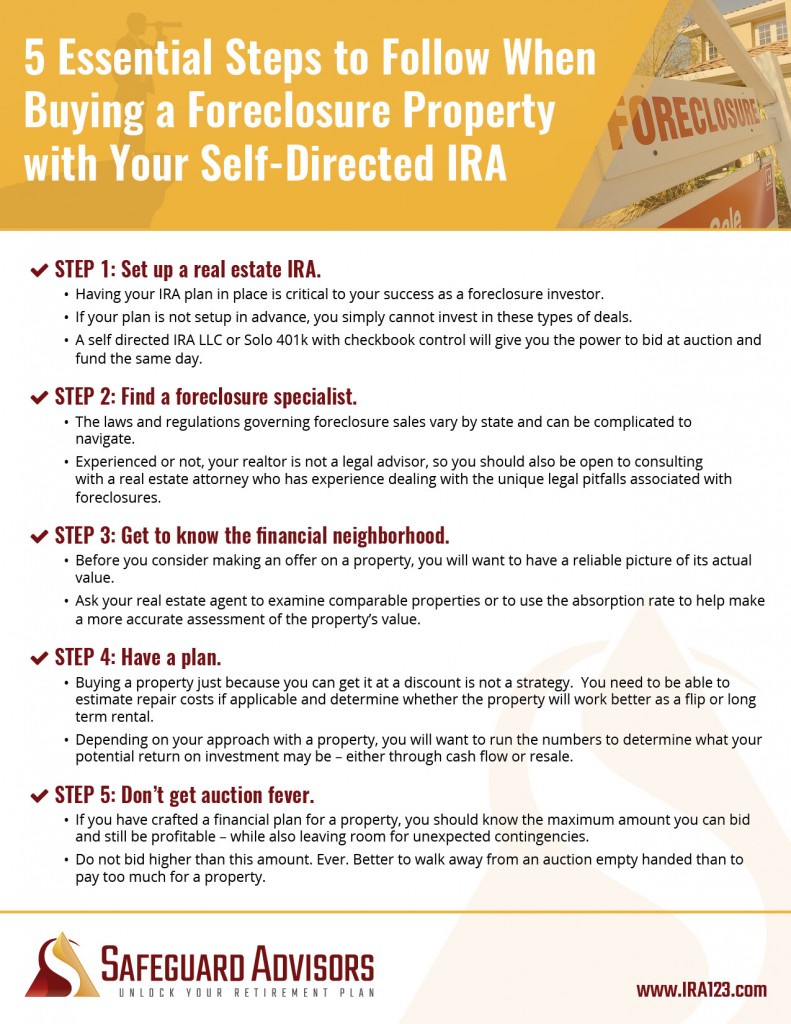
Step 1: Set up a real estate IRA.
Having your IRA plan in place is critical to your success as a foreclosure investor. When the right deal comes along, you need to act… now. If your plan is not setup in advance, you simply cannot invest in these types of deals.
Step 2: Find a foreclosure specialist.
The laws and regulations governing foreclosure sales vary by state and can be complicated to navigate, so finding a real estate agent who specializes in the foreclosure market should be a top priority. In 2009, the National Association of Realtors introduced a Short Sale and Foreclosure Certification Program, and the Distressed Property Institute offers a Certified Distressed Property Expert program. One of these certifications may be something to look for in a realtor, but if your agent doesn’t have a certification, they may have enough experience in the process to guide you through it, so ask them how many short sales or foreclosures they have closed before you hire them (about a dozen is ideal). Experienced or not, your realtor is not a legal advisor, so you should also be open to consulting with a real estate attorney who has experience dealing with the unique legal pitfalls associated with foreclosures.
Step 3: Be realistic about the timeframe.
There can be serious financial repercussions to jumping headlong into any investment, so make sure you are acquainted with the time it may take to see returns on your property. If your foreclosed home purchase declines further in value, can you afford to hang onto it? What will your costs on the property be over five or ten years? What will the returns be like if you are not able to set the rent as high as you intend? Get the concrete numbers worked out before you invest, and be absolutely certain that they fit your financial goals and needs.
Step 4: Get to know the financial neighborhood.
Before you consider making an offer on a property, you will want to have a reliable picture of its actual value. Ask your real estate agent or use a website like zillow.com to examine comparable properties. Comparables are properties sold within the last 12 months that are in the same area and are comparable in size, style, age, and condition. Since market activity fluctuates, it can be difficult to find accurate comparables at certain times. In an active market, there will be more comparables to choose from and in a slower market, there will be fewer. In the latter case, your real estate agent can use the absorption rate to help make a more accurate assessment of the value of the property. The absorption rate is the rate at which homes are selling in a specific area, which reflects supply and demand in the market. If the absorption rate has slowed, they may project a lower value for the property, but if the rate has increased, the projected value of the property is likely to be higher.
Step 5: A foreclosure is just like any other closeout sale.
When you purchase a foreclosure property, you are already purchasing below market value, so you should not expect to get the price discounted to compensate for defects such as needed repairs. It is important to approach the transaction with a clearance-sale mindset, in that you are getting a really good deal because the merchandise is sold as-is.
Take a look at our checklist below. Click here to download the PDF.




What our clients says about us

Quick answers to common questions
We’ll take you through a simple, step by step process designed to put your investment future into your own hands…immediately. Everything is handled on a turn-key basis. You take 100% control of your Retirement funds legally and without a taxable distribution.
YES! In 1974, Congress passed the Employee Retirement Income Security Act (ERISA) making IRA, 401(k) and other retirement plans possible. Only two types of investments are excluded under ERISA and IRS Codes: Life Insurance Contracts and Collectibles (art, jewelry, etc.). Everything else is fair game. IRS CodeSec. 401 IRC 408(a) (3)
It’s actually pretty simple. Early on, regulators let the securities industry take the lead in educating the public about retirement accounts. Naturally, brokers and banks promoted stocks, bonds, and mutual funds—giving the impression that those were the only allowed investments. That was never true... and still isn’t. You can probably guess why they kept the rest under wraps.
It is possible to use funds from most types of retirement accounts:
- Traditional IRA
- Roth IRA
- SEP IRA
- SIMPLE IRA
- Keogh
- 401(k)
- 403(b)
- Profit Sharing Plans
- Qualified Annuities
- Money Purchase Plans
- and many more.
It must be noted that most employer sponsored plans such as a 401(k) will not allow you to roll youraccount into a new Self-Directed IRA plan while you are still employed. However, some employers will allow you to roll a portion of your funds. The only way to be completely sure whether your funds are eligible for a rollover is by contacting your current 401(k) provider.
A Solo 401(k) requires a sponsoring employer in the format of an owner-only business. If you have a for-profit business activity – whether as your main income or as a side venture – and have no full-time employees other than potentially your spouse, your business may qualify. The business may be a sole-proprietorship, LLC, corporation or other entity type.
A self-directed retirement plan is a type of IRA or 401(k) that gives you greater control over how your retirement funds are invested. Unlike traditional accounts held at banks or brokerage firms that limit you to stocks, bonds, and mutual funds, self-directed plans allow you to invest in a wide range of alternative assets including real estate, private businesses, precious metals, cryptocurrency, and more.
These plans still follow the same IRS rules and maintain the same tax-deferred or tax-free benefits as conventional retirement accounts. The difference is simply in how and where you choose to invest.
No. Moving to a self-directed IRA or Solo 401(k) does not trigger any taxes, as long as your funds are eligible for rollover.
Self-directed retirement plans maintain the same tax-advantaged status as traditional plans offered by banks or brokerage firms. The key difference is flexibility—our plans are designed to give you greater control and allow for a wider range of alternative investments beyond stocks, bonds, and mutual funds.
A prohibited transaction is any action between your retirement plan and a disqualified person that violates IRS rules and can lead to serious tax consequences. Under IRS Code 4975(c)(1), prohibited transactions include:
- Selling or leasing property between your plan and a disqualified person Example: Your IRA cannot purchase a property you already own.
- Lending money or extending credit between the plan and a disqualified person Example: You cannot personally guarantee a loan your IRA uses to buy real estate.
- Providing goods or services between your plan and a disqualified person Example: You can’t use your personal furniture to furnish a rental property owned by your IRA.
- Using plan income or assets for the benefit of a disqualified person Example: Your IRA cannot buy a vacation home that you or your family use.
- Self-dealing by a fiduciary (using plan assets for their own benefit) Example: Your CPA shouldn't loan your IRA money if they’re advising the plan.
- Receiving personal benefit from a deal involving your IRA's assets Example: You can’t pay yourself from profits your IRA earns on a rental.
If a transaction doesn’t clearly fall within the allowed guidelines, the IRS or Department of Labor may review the situation to determine if it qualifies as a prohibited transaction.
Disqualified persons are individuals or entities that are prohibited from engaging in certain transactions with your IRA or 401(k). Doing so could trigger a prohibited transaction, which may result in taxes and penalties.
Here’s who is considered a disqualified person:
- You (the account holder)
- Your spouse
- Your parents, grandparents, and other ancestors
- Your children, grandchildren, and their spouses
- Any advisor or fiduciary to the plan
- Any business or entity owned 50% or more by you or another disqualified person, or where you have decision-making authority
These rules exist to prevent self-dealing and ensure your retirement plan remains in compliance with IRS regulations.
(Reference: IRC 4975)
Understanding and following these rules can be tricky, but it’s very doable. The best way to stay compliant is to work with professionals who specialize in self-directed retirement plans. They can help you navigate IRS guidelines and avoid prohibited transactions.
If an IRA holder is found to have engaged in a prohibited transaction with IRA funds, it will result in a distribution of the IRA. The taxes and penalties are severe and are applicable to all of the IRA’s assets on the first day of the year in which the prohibited transaction occurred.
Yes. While self-directed retirement plans allow for a wide range of investments, there are a few important restrictions.
You cannot invest in collectibles or life insurance contracts, and you must avoid prohibited transactions—activities that benefit you personally rather than the retirement plan. These include things like buying or selling property to yourself or family members, using plan assets for personal gain, or self-dealing in any way.
Violating these rules could cause your entire IRA to lose its tax-advantaged status. To protect your account, it’s essential to work with professionals who understand IRS regulations and can help you stay compliant.
This is a common misconception. In many cases, professionals may simply be unfamiliar with self-directed retirement plans, as they fall outside their usual scope of work. CPAs and tax preparers are trained to file taxes, not necessarily to advise on alternative retirement strategies. Financial advisors and brokers often work for firms that focus on traditional investments like stocks and mutual funds—and may not benefit from or support alternative options like real estate or private lending.
Self-directed retirement investing is legal under IRS rules—but like any specialized area, it requires working with professionals who understand how it works.
The IRS has rules in place to make sure your IRA is used only for the exclusive benefit of the retirement account—not for personal gain or to help family members. These rules can get complicated because there are many ways a conflict of interest can occur, even unintentionally.
For example, if your IRA buys a house and rents it to your mother, you might be reluctant to evict her if she stops paying rent. That emotional connection creates a conflict between what’s best for your IRA and your personal relationships, something the IRS aims to prevent.
These rules help ensure your retirement account stays compliant and protected. (See IRC 408)
Yes. Most tax-deferred retirement accounts—such as Traditional IRAs, old 401(k)s, 403(b)s, and TSPs—can be rolled over into a self-directed IRA or Solo 401(k), depending on your eligibility. Roth IRAs cannot be rolled into these accounts.
You can contribute directly from earned income, subject to annual IRS contribution limits. The method and amount depend on the type of plan you have (e.g., Solo 401(k) vs. IRA).
To take a distribution, you'll request funds through your custodian or plan administrator. Distributions may be taxable depending on your account type and age. Early withdrawals may be subject to penalties.
For 2025, the Solo 401(k) max contribution limit is $83,250 if age 60-63, $80,000 if age 50-59 or 69+, and $72,000 if under 50. Traditional and Roth IRAs have a limit of $7,000 ($8,000 if age 50+). Limits are subject to IRS adjustments.
Yes. IRA contributions are typically due by your personal tax filing deadline (e.g., April 15). Solo 401(k) contributions follow your business tax filing deadline, including extensions.
IRS reporting requirements vary depending on the type of self-directed retirement plan you have. Here’s a quick breakdown of what you need to know
Please note: Our team can help you understand what’s required for your specific account, but we don’t provide tax or legal advice. We always recommend working with a qualified tax professional to ensure full IRS compliance.
Self-Directed IRA (Traditional or Roth)
- Form 5498 – Filed by your custodian each year to report contributions, rollovers, and the fair market value (FMV) of your account.
- Form 1099-R – Issued if you take a distribution or move funds out of your IRA.
- Annual Valuation – You'll need to provide updated FMV for any alternative assets held in the account, such as real estate or private placements.
Solo 401(k)
- Form 5500-EZ – Required if your plan assets exceed $250,000 as of year-end. Must be filed annually by the plan participant.
- Form 1099-R – Required if you take a distribution or roll funds out of the plan.
- Contribution Tracking – Keep records of employee and employer contributions. These are not filed with the IRS but may be needed for tax reporting or audits.
SEP IRA
- Form 5498 – Filed by your custodian to report contributions and FMV.
- Form 1099-R – Filed by your custodian. Issued for any distributions.
- Employer Contributions – Must be reported on your business tax return (and on employee W-2s, if applicable).
Health Savings Account (HSA)
- Form 5498-SA – Filed by your HSA custodian to report contributions.
- Form 1099-SA – Filed by your HAS custodian. Issued for any distributions.
- Form 8889 – Must be included with your personal tax return to report contributions, distributions, and how funds were used.